

British Columbia lost an estimated 5,500 jobs in August, while the province’s unemployment rate increased to 6.5%, according to the latest Labour Force Survey.
Across Canada, employment declined by approximately 42,000 jobs in August, while the national unemployment rate remained at 6.4%. Statistics Canada reported that employment in B.C. edged down 0.2% to approximately 2.95 million.
The B.C. government characterized the latest numbers as evidence of resilience during continued economic uncertainty related to U.S. tariffs.
Adrian Dix, acting Minister of Jobs and Economic Growth, said businesses and workers continue to face challenges from tariffs imposed by U.S. President Donald Trump, particularly in sectors such as forestry.
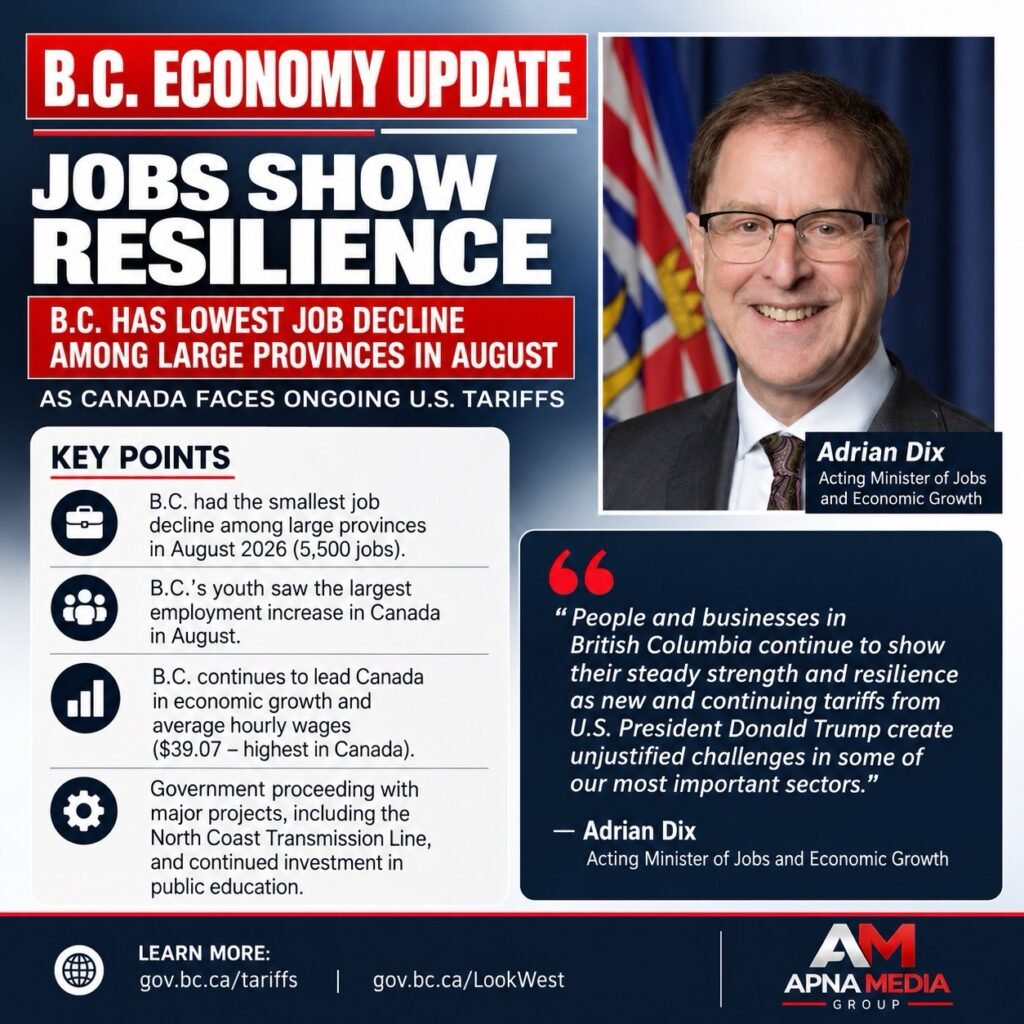
B.C.’s government is pointing to economic resilience after employment edged down by 5,500 jobs in August and the provincial unemployment rate rose to 6.5%.
The provincial statement also pointed to the 50,800 jobs it says were added in B.C. between May and July, before August’s decline.
Statistics Canada’s data show B.C.‘s unemployment rate increased from 6.2% in July to 6.5% in August. Ontario’s unemployment rate was 6.9%, while Alberta’s was 6.8%.
The province said B.C.’s average hourly wage reached $39.07 and highlighted investments in major infrastructure, schools and the North Coast Transmission Line as part of its broader economic strategy.
The government says it is also working to diversify B.C.’s economy and reduce dependence on the United States as a trading partner.
Nationally, Statistics Canada said industries dependent on U.S. export demand continue to operate in an uncertain environment following new U.S. tariffs on Canadian exports.
The provincial government’s comments were released September 4 following publication of the August Labour Force Survey.
Source: Statistics Canada Labour Force Survey, August 2026; B.C. Ministry of Jobs and Economic Growth.



0 Comments
Subscriber comments
Sign in with your subscriber account to join the conversation.